T
Technician role
Creates jobs, runs checklists, captures evidence, completes sign-off. Cannot invoice or mark jobs complete. Sees only the active workflow — billing and closure options are not visible in the interface.
FOR WORKSHOP MANAGERS
Stop chasing status updates on the phone. Engine Room gives your whole team a live, structured view of every job from intake to close-out — with the compliance record built in as work happens.
JOB LIFECYCLE
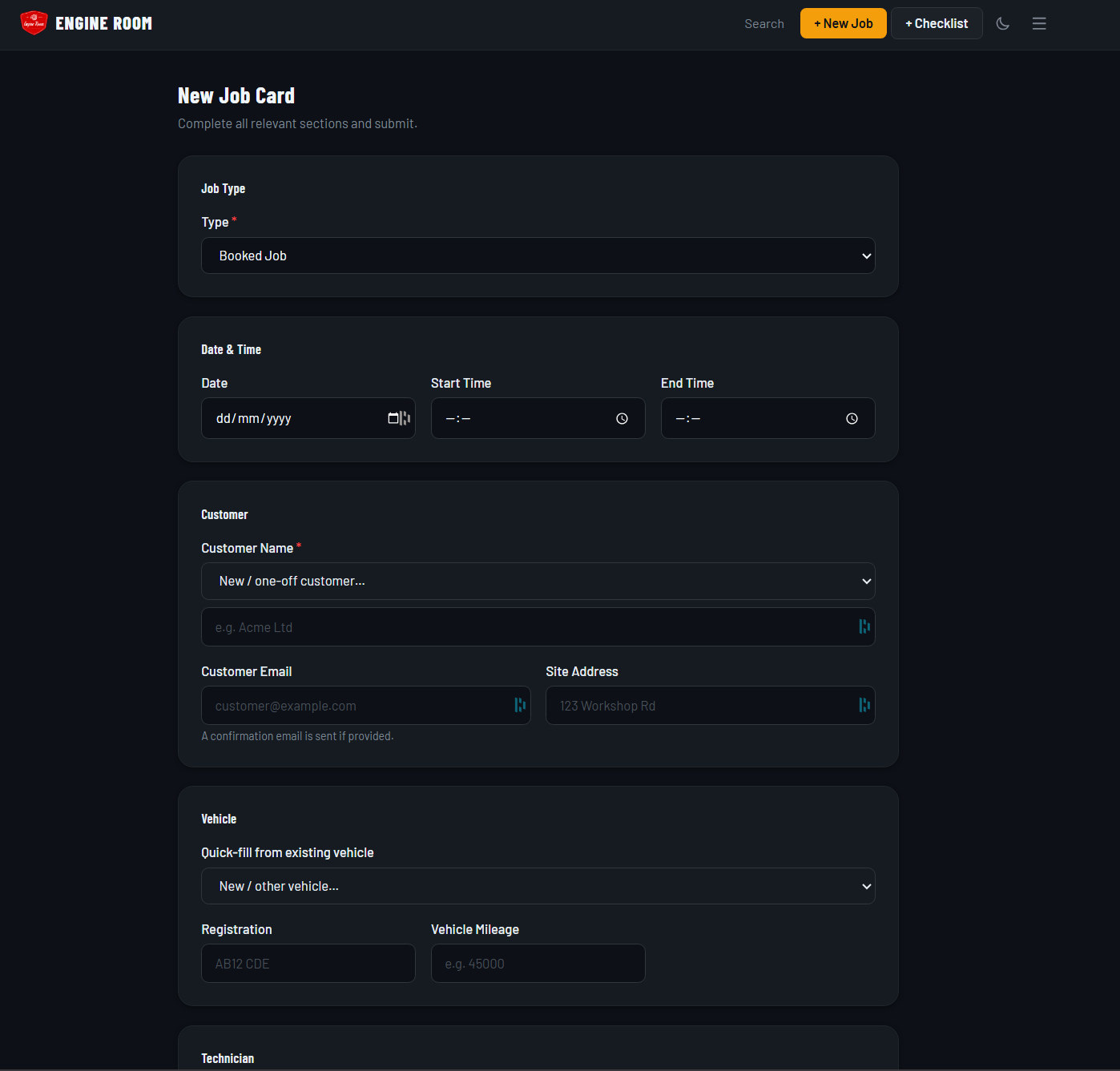
Job card created with vehicle, customer, and job type. Assigned to a technician. Visible to the whole team immediately.
Technician begins work. Checklists can be attached and completed. Evidence photos uploaded to specific checklist items.
Technician completes the DVSA sign-off: inspection type, defect category, next PMI date, and digital signature. Job record sealed. PDF certificate generated immediately.
Admin sends the job record and PDF certificate to the customer. Record shows who sent it and when.
Admin-only transition. Technicians cannot move a job to invoiced — enforced at the API with a 403, not just hidden in the UI.
Job closed. Full record retained: job details, checklist responses, evidence photos, sign-off package, and event history.
STRUCTURED CHECKLISTS
Checklist items use structured response types: pass/fail, yes/no, numeric with unit (lux, PSI), tread depth (mm), brake efficiency (%), date picker, or defect note. Responses are data, not text to interpret later.
Required items must have a response before the checklist can be submitted. There is no override. Partial records do not exist — you get a complete inspection or an in-progress one.
Checklists are built from templates. The same 74-item PMI runs the same way every time, on every device, regardless of which technician runs it.
Checklists are linked to a specific site at creation. Templates and equipment registers are scoped correctly for the location where the inspection takes place.
EVIDENCE CAPTURE
Each photo is stored against the specific checklist item that generated it. The chain from defect to inspection to record is unbroken and retrievable in seconds.
Technician sign-offs are captured as evidence items linked to the checklist submission. The signature is treated the same way a photo is — traceable, retrievable, not just a checkbox.
Photos taken on the React Native app are uploaded and tagged identically to web uploads. No sync gap, no separate mobile record — one unified evidence store.
TEAM ROLES
Creates jobs, runs checklists, captures evidence, completes sign-off. Cannot invoice or mark jobs complete. Sees only the active workflow — billing and closure options are not visible in the interface.
Full access to all jobs and records. Manages users, sites, vehicle register, checklist templates, LOLER equipment, and COSHH substances. Owns invoiced and complete transitions.
Role enforcement is not a UI toggle — it is applied at the API layer. A technician making a direct API call to invoice a job receives a 403.
THE BIGGER PICTURE
Every PMI, DDR, and LOLER inspection you run in Engine Room produces a signed, tamper-evident compliance record. Not a PDF you printed and filed. A structured record — retrievable by vehicle, by date, by technician, by defect category.
Your customers — the operators whose fleets you maintain — need to show DVSA that their vehicles are being inspected to the right standard. The record you create in Engine Room is exactly that proof. You send it to them. They keep it. Everybody's covered.
Workshops that produce clean, digital, DVSA-aligned records get renewed without question. Workshops that can't produce the evidence get replaced. Engine Room makes you the workshop that every fleet manager keeps coming back to.
The workshop market is underserved — paper-heavy, with desktop-era software built for office managers rather than technicians. Engine Room is built for the floor first. The compliance trail is a byproduct of the work, not an extra job at the end of it.
Join the pilot cohort. We onboard workshop teams directly and work through setup together.
Request Early Access